

Charlotte and her parents share their poignant story
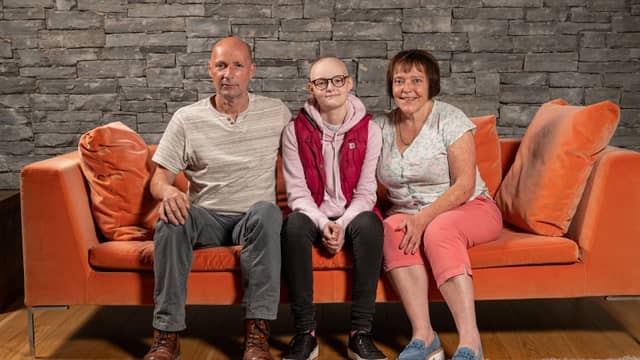

CHARLOTTE began her description of her experience by saying, “It started as headaches, sickness, dizziness and feeling really clumsy. “Then it got really bad and I had to take time out of school every week. Sometimes I just had to stay in a dark room for two to three days.
CHARLOTTE began her description of her experience by saying, “It started as headaches, sickness, dizziness and feeling really clumsy.
“Then it got really bad and I had to take time out of school every week. Sometimes I just had to stay in a dark room for two to three days.
“I could barely eat anything and the pain in my head was unbearable.
“When I was diagnosed, I felt relief that there was a reason for all the pain.
“After surgery it was really hard trying to process everything. I felt I had no control over myself. I was really sensitive to noise around the hospital so I was moved to my own wee room and it was like heaven.
“I also loved getting my wheelchair because it gave me freedom to move around and get away from the busy ward.”
Before radiotherapy began a mask for her to wear during the treatment was made. Treatment entailed Charlotte – her face in the mask - lying on her stomach for three hours.
“I couldn’t breathe and it made my dizziness so much worse,” she said. It was really claustrophobic in addition to which she felt fear. Her head was enclosed in the mask which was screwed to the table. There were 31 such treatments.
This was followed by four high-dose chemotherapy treatments in an isolation room, with each session lasting about 23 days.
“My saving grace was Lucy, the light of my life, from Cancer Fund for Children. She had just started as a Cancer Support Specialist with the charity and I was her first patient.
“Lucy really brightened me up. Although I didn’t want to do anything, I still did it. And then I started doing things because I wanted to. I looked forward to Lucy’s visits; she gave my day a purpose.
“When I was discharged, I just felt so alone. We were so used to the routine in the hospital and I felt secure.
“But then, all of a sudden, you’re out home and you just feel lost.
“One of the hardest things has been losing my sight. And noise still annoys me. I also have to use a wheelchair because of the fatigue - and there’s not as much awareness of disability as there should be.
“I still have to go through MRIs every three months and I feel very tense until the results come back because you just don’t know. Things can change very quickly.”
Throughout this lengthy process, Charlotte’s parents Ernestine and Thomas had to leave their other children at home in the care of family members in order to support Charlotte through her treatment.
Mum Ernestine said, “We were told the treatment plan and that it would be very aggressive.
“Charlotte also had a stem cell harvest which was returned after each chemo to speed her recovery. It was traumatic to watch her go through all she did. Our goal every day was to help her get through radiotherapy.
“It’s also really hard because you have other family at home and you’re just very separated. Even though family members helped out it’s a massive transition for everyone.
“We really just left home for months.”
Charlotte’s treatment may be over, but her condition continues to have a lasting impact on her life - and that of her family.
Her parents’ hope is that by sharing their story, they can raise awareness that the consequences of cancer can last beyond treatment, and the importance of a small gesture or a kind word.
“People think Charlotte is better but the doctor said there’s a reason you only get four high doses of chemo.
“Your body is pushed to the limit, so after treatment, there’s still a lasting impact.
“You’re mentally and physically drained. You’re still very worried about infections and there are endless appointments. You’re living from one MRI to the other. You try to be positive but this process does take its toll.
“We are very thankful to have met some amazing people along the way and that’s one of the reasons we’ve got through treatment.
“The staff in the hospital think they are just doing their jobs but to us they go that little bit extra and sometimes something as simple as a kind word or smile can make such difference.”
Visit the Cancer Fund for Children’s website today to find out how you can help ensure none of these children and their families have to face childhood cancer alone. https://cancerfundforchildren.com/event/childhood-cancer-awareness-month