

Final note sounds on Armagh's William Kennedy Piping Festival
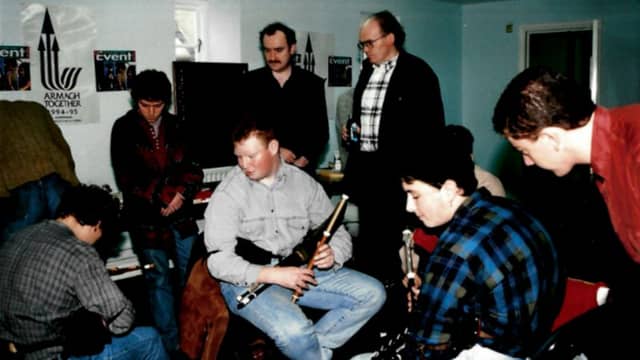

THE final note has been sounded on the world famous William Kennedy Piping Festival which has been a centrepiece of cultural life in Armagh city for 30 years. The Armagh Pipers Club, the traditional music teaching organisation, which organises the event this afternoon (Thursday, February 6) made the announcement it would be moving its focus to other activities.
THE final note has been sounded on the world famous William Kennedy Piping Festival which has been a centrepiece of cultural life in Armagh city for 30 years.
The Armagh Pipers Club, the traditional music teaching organisation, which organises the event this afternoon (Thursday, February 6) made the announcement it would be moving its focus to other activities.
The club, now in its 60th year of activity recently moved its base from Scotch Street to the Aonach Mhacha cultural centre in the city.
With the its long history in mind, the club has been taking stock of its achievements and thinking about its future direction.
A spokesperson said, “It has decided that, after 30 years of devoting a vast amount of its energy and resources to running the international William Kennedy Piping Festival, it is time to move on and focus on other activities.
“It is extraordinary that a relatively small charity managed, against increasing financial constraints, to present 30 consecutive editions of a festival that, from modest local beginnings, became known and celebrated all over the world.
“This was driven by voluntary effort and dedication, and the Club looks back with pride on what it achieved.”
In 1994 the then Armagh City & District Council announced the Armagh Together Festival, with the aim of reinforcing community spirit in the Council area.
Armagh Pipers Club Director of Music Eithne Vallely proposed an event commemorating the piper and master craftsman William Kennedy, who was born in Tandragee in 1768.
Kennedy’s name had been largely forgotten in his home country, but in the 19th and early 20th centuries the inspirational story of this remarkable blind genius was celebrated in schoolbooks, magazines and newspapers in Ireland, Britain and as far away as Italy, Germany, France, Australia and North, Central and South America.
His contribution to the piping world was his modernisation of the bellows-driven pastoral or union pipes, giving him a credible claim to be the inventor of today’s uilleann pipes – though he also sought to improve the Highland bagpipes.
The first Kennedy Festival was therefore based on the piping traditions of Ireland and Scotland, reflecting the Pipers Club’s philosophy that the music of both countries is the shared heritage of us all.
It proved such a success that, by popular demand, the Club immediately began organising a second festival for the following year.
From this the festival grew organically, bringing in representatives of other bagpiping traditions from Europe and further afield.
It gradually became the single most important international festival of all forms of pipe-based music, reaching out across five continents to welcome pipers and pipe enthusiasts from all over the world.
The organisation of the Festival has largely been the work of volunteers, with Club founder Brian Vallely the unpaid festival director for many years, helped more recently by his son Caoimhin in the role of Artistic Director and Club secretary Ciarán Ó Maoláin co-ordinating the administration and liaising with funders.
Over its 30 years the William Kenndy Piping Festival brought to Armagh over 1,100 musicians from countries as diverse as Iran, Algeria, Spain, Portugal, France, Belgium, Netherlands, Sweden, Germany, Canada, Brazil, the USA, Hungary, Belarus, Croatia, Macedonia, Italy, Bulgaria, the Czech Republic, Japan, Luxembourg, Romania and Greece, as well as Ireland, England, Scotland and Wales.
From within those countries the festival featured many unique piping traditions: from Italy it presented pipers from Piedmont, Sicily, Sardinia and Southern Italy.
Spain was another country with a rich piping tradition and Armagh had representatives of the distinctive piping genres of Galicia, Asturias, Catalonia and Mallorca, with the northern and southern regions of the Basque Country also featured.
A big input came from France, which has been described as the heartland of piping, with no fewer than 14 historic piping traditions represented including the well-known Breton pipes and the lesser-known instruments of Burgundy, Gascony, the Massif Central, Corsica and the Occitan region.
The festival’s initial emphasis was on solo unaccompanied piping, featuring some of the most high-profile piping legends such as Kathryn Tickell playing the Northumbrian pipes, maestro Luigi Lai from Sardinia playing the launeddas, and the renowned gaitero José Manuel Tejedor of Asturias.
It subsequently featured other instruments and pipe-based groups, from the never-to-be-forgotten duet of Catherine Ennis on the organ with Liam O’Flynn playing uilleann pipes, to internationally famous groups such as Lúnasa and Capercaillie. Another initiative was to include Highland pipe bands, beginning with local All-Ireland Grade 2 champions the Killeen Pipe Band, and multiple Grade 1 World champions, the Field Marshal Montgomery Pipe Band.
Many artists returned again and again: those who performed in 10 or more editions of the Festival included Anxo Lorenzo of Galicia, Ailean Domhnallach (Allan Mac Donald) from the Western Highlands of Scotland, Angus MacKenzie of Cape Breton and Skye, and Irish musicians Barry Kerr, Sinéad Lennon Walsh, Caoimhín Vallely, Mick O’Brien, Brian Vallely, Jarlath Henderson, Niall Vallely, Éamonn Curran, Tiarnán Ó Duinnchinn and Cillian Vallely.
The Festival also hosted the work of composers and arrangers such as Mícheál Ó Suilleabháin, Lorcán Mac Mathúna, Niall Vallely and Dónal O’Connor. Mac Mathúna premiered his ‘Book of Leinster’ composition while Niall Vallely premiered his ‘Singing Stream’, a composition for four uilleann pipes.
Ó Suilleabháin brought the Irish Chamber Orchestra to perform along with musicians from the Armagh Pipers Club in an original composition inspired by the influence of the 18th century Italian composer and violinist Francesco Geminiani, whose work had influenced the Irish harper Turlough O’Carolan. (Geminiani had moved to Dublin in 1759, dying there in 1762.)
O’Connor arranged the unique ‘Song of the Chanter’ four-part arrangement for 45 uilleann pipes to celebrate the 45th Anniversary of Armagh Pipers Club in 2011.
Another initiative was the Mark Donnelly Academy of Piping, supported by the family of Mark Donnelly, a pipe tutor in the club who died at a young age in 1999.
The Academy acquired an international dimension with students coming from all over the world to experience tuition with renowned uilleann pipers such as Mick O’Brien, Cillian Vallely and Pádraig McGovern.
Central to the William Kennedy Festival over the years has been the Lecture series celebrated in the publishing of a compilation of lectures selected from some 54 delivered during the first 25 years of the festival.
With the help of live recordings made by the Irish Traditional Music Archive, there have been compilation CDs featuring Festival music selected by Caoimhin Vallely.
The festival has received many accolades over the years including the Irish Music Magazine ‘Best Festival’ award.
But any international music festival requires financial support and a good hospitality infrastructure, and neither was available to the extent required.
The Club received consistent support over the years from Armagh City & District Council and later Armagh, Banbridge and Craigavon Borough Council, but only intermittent and variable support from the Arts Council of Northern Ireland.
Smaller but much-appreciated support came from the Armagh business community, and other donors and supporters.
In the absence of sufficient public funding the Club itself became a major funder, with up £20,000 annually expended from its own reserves.
The Festival struggled over the years with limited hotel accommodation in the city, which proved a major obstacle to attracting the crowds needed to ensure a healthy box office.
Every available room, and self-catering accommodation, was usually booked up well in advance by Festival patrons, many travelling from Britain or the European mainland. Bookings for the 2024 Festival came from 18 countries.
As for its next steps: the Club is of course planning to continue its renowned education programme, which delivers over 1,000 hours per year of high-quality, low-cost tuition in eight traditional instruments and singing.
It will also deliver a range of concerts by visiting artists, and its own massive Annual Concert, which this year takes place on 9th March in the Market Place Theatre.
The spokesperson said, “Without the drain on its resources that the Festival imposed, it should have more freedom to organise big-name concerts, and these are likely to include an annual William Kennedy Piping Concert to keep alive the memory of that great son of Tandragee.
For the Pipers Club, its director Brian Vallely said: “We know that many in the global piping community will be very sorry to hear of the end of the ‘Kennedy’, but from the many messages we have had from those who attended – some of them year after year – we also know that there is a massive sense of gratitude to the small team, from a small charity, that managed to present this great spectacle for three full decades.
“We hope that those who have developed the habit of coming to Armagh will keep coming to us, and we will welcome them; we thank the many, many thousands of musicians and audience members who shared the music with us from 1994 to 2024.”