

New song a joint venture between Derrynoose and Tydavnet

‘Celebratory Gathering’ is the culmination of many months of hard work between two border communities, Derrynoose and Tydavnet
A new song/musical composition is to be launched in the exquisite Peace Campus Monaghan on Friday, 27 November.
This ‘Celebratory Gathering’ is the culmination of many months of hard work between two border communities, Derrynoose and Tydavnet.
Both communities have an enduring sense of pride in their shared heritage. They have patron saints, Mochua and Dympna, ancient monastic sites and old graveyards.
The popularity of their holy wells has never waned through the generations, and they continue to draw people from far and near for healing, calm and peace.
The project has facilitated the sourcing and collecting of many songs, stories, photographs, musical pieces as well as townland meanings, and information about cures, superstitions, match making, family trees, eviction, emigration, farming and employment trends. This data will form the basis of a new website ‘Tydanoose’ which will also be launched at the event.
The ‘Tydanoose Project’ has secured funding from PEACEPLUS, a project managed by the Special EU Programmes Body (SEUPB), which is a cross-border funding Programme designed to support peace and prosperity across Northern Ireland and the border counties of Ireland and has a total value of €1.14 billion, to be delivered over the next four years.
This has enabled the local Heritage Group to undertake electromagnetic survey into fields in the townland of Listrakelt. the results demonstrate archaeological evidence of the probable location of the old monastic site. This merits further investigation in the future.
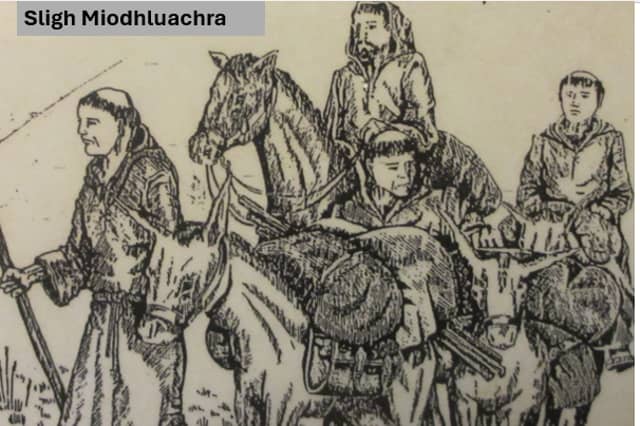
The new exciting song/musical piece celebrates the arrival of St Mochua to Derrynoose 1400 years ago. The ten-verse piece tells of Mochua coming along the ‘Sligh Mioudhluachra’, an ancient routeway from Tara to the North. There is a reference to ‘this locus montanus’, a mountainy place in Daire Colla Uais (Derrynoose) in Sliabh Fuaidh where he built the monastery.
One of his first challenges was to banish the spell of Crom Cruach, the ancient druid, with his ritualistic cursing stone and evil spells. Mochua’s answer was to pray with deep and solemn incantation, invoking the Lord and all his saints. Mention is made of the various roles his monks had to perform in the monastic cycle to survive and promote the gospel in their mission of conversion.
“Our scribes will copy psalms all day,
Others work with sickle and flail,
Observing silence as they pray
‘Veni, vidi, vice’ on the pilgrim trail,” said he, said he,
‘Veni vidi vice,’ said he.”
The composition is rich in content, with an accurate and well researched narrative, interwoven with rare rhyming and it will be delivered in choral harmony along with harp, fiddle and flute accompaniment.
A spokesperson for the joint committee said, “New songs are being composed almost on a daily basis about random things, but I doubt very much if anyone has written a song about something that happened 1400 years ago, something that has still a profound effect on the local people. This was the beginning of the great monastic age, a time of enlightenment and the song embodies all the great marvels and happening of that time. It is really a celebration of the significant work of Mochua, Dympna and the monastics of that time who lit a flame which still burns.”
The gathering takes place in the Peace Campus Monaghan on Friday 27 at 3.15pm. This is a free event, and booking is necessary through Eventbrite of by emailing [email protected].