

Poignant occasion as Legion marks 100th anniversary of Armagh’s War Memorial
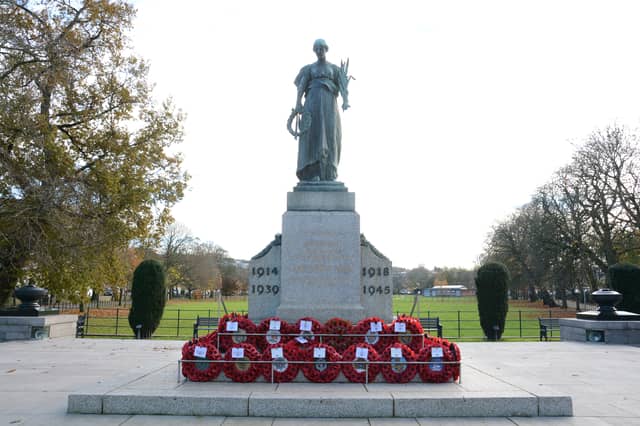

The service will take place at 3pm on Sunday
THE Royal British in Armagh will mark the centenary of the dedication of the War Memorial at the Mall with a special service taking place on Sunday, November 29.
They will be attempting to recreate the original dedication ceremony with the modern equivalents of those who took part in the original ceremony attending.
The ceremony will also be attended by the Catholic Archbishop of Armagh, Archbishop Eamon Martin. The Catholic Church had not been represented at the original dedication.
The service will take place at 3pm on Sunday and will also be attended by representatives from the main Protestant Churches.
Cannon Malcolm Kingston will represent the Church of Ireland (with Archbishop John McDowell unavailable).
The Presbyterian Church will be represented by a familiar face on the Mall, Rev Peter Gamble (former Minister of the Mall Presbyterian Church) representing the Moderator.
And Rev Colin Gracie of Armagh Methodist Church will represent the President of the Methodist Church).
Others attending will be the Deputy Lord Lieutenant for County Armagh Col Simon Cassell, the High Sheriff and Deputy Lord Mayor of Armagh, Banbridge and Craigavon Council Alderman Lavelle McIlwrath.
Royal British Legion spokesman David Hammerton said, “We are delighted to have them all attending.
“The service will follow as closely as possible the dedication ceremony that took place in 1926. We will use the same prayers and we tried to get the same enactors, due to availability issues some will have their representatives attending.”
The War Memorial itself is virtually unchanged since it was dedicated in 1926 - bar two important amendments.
In the 1970s the Memorial was raised up on a platform with more steps to reach its level.
And in 2021 some 520 names were added to the Memorial .
When the memorial was first unveiled on December 3, 1926, it had no individual names inscribed because organisers felt it was impossible to compile a complete list without omitting anyone.
After painstaking research by the Royal Irish Fusiliers Museum and local volunteers the names were added on Memorial tablets on the corners of the Armagh War Memorial.
Leading figures in that research were Joe Center, Amanda Moreno, Stanley Burrows and Arthur Clark.
Sunday’s ceremonies will begin with the parade moving off from the British Legion Premises at Dobbin Street Dobbin Street to Dobbin Street Junction, Barrack Street, The Mall West to The Cenotaph for a short service there starting at 3pm.
There will then be a service in the Mall Presbyterian Church.
The Armagh War Memorial was unveiled on the 3rd December, 1926 by his Grace the Governor of Northern Ireland, James Albert Edward Hamilton, 3rd Duke of Abercorn .
Newspapers at the time reporter: “The Duke was accompanied by the Duchess, and as it was their first official visit the historic city held holidays. Flags fluttered and waved their welcome long before the hour of the ceremony townsfolk had taken up their positions in the Mall, where the memorial, flanked by a couple of guns, occupies such a commanding position.”
A number of addresses were presented to his Grace by representatives of public bodies, including the Armagh County Council (Messrs. T.A. Montgomery, D.L., chairman; E. Cowdy, D.L., vice-chairman, and T.E. Reid, M.B.E. secretary) the Dean and Chapter of Armagh Cathedral (Very Rev. the Dean R.G.S. Hamilton, Canon Tichborne, and the Venerable Rev. Archdeacon Irwin); Armagh Presbytery (Rev. Thomas McKinney, Moderator; Mr. W.M. Clow, J.P. and Rev. H.W. Perry, clerk); Armagh Regional Educational Committee (Messrs. J.S. Carrick, acting chairman; Quinn, B.A. and J. Harland, J.P.); Armagh Rural Council and Board of Guardians (Messrs. T.H. Hardy, J.P. chairman of the Council; T. Mann, acting chairman, and W.T. Todd); Newry No. 2 Rural Council (Messrs. G. Clorey, vice-chairman and W.R. Bell, J.P., clerk); Lurgan Rural Council (Messrs. J. Walsh, J.P., chairman, and G.H. Gracey); Armagh Grand Orange Lodge (Sir James H. Stronge, D.M.; Rev. R.J. Wham, County Grand Chaplain, and Mr G Crosier, County Grand Secretary).
Replying to the addresses His Grace said:- “It gives the Duchess of Abercorn and myself very great pleasure indeed to visit this ancient and beautiful city. The warmth of your welcome has touched us very much indeed, and I would ask you to convey to the bodies which you represent my sincere thanks for those loyal and dutiful addresses, which express a spirit of extreme friendship towards my wife, and myself.
“The main purpose of my visit to your city today is to perform what is, in many ways, an extremely sad ceremony, but I feel that this setting up of memorials to those of our race who fell in the great war is a duty of this generation, and an example to all those who follow after.”
He added, “Our thoughts today inevitably turn towards those who lost their lives in that great struggle, but I would ask you at the same time to remember that there are many amongst us who are suffering and many who are in need, and therefore I would charge you never to forget the ex-service men and women.
“I hope today to take advantage of my visit to see some portion of your city, and I am indeed glad to have this opportunity of meeting the representatives of the many and varied interests in the City of Armagh and neighbour.”
The Duke went on, “I feel, myself that the troublesome times through which we have lately lived are passing away, and there is a prospect of increased prosperity for our native land, and with this hope I express the wish that the city and the county of Armagh may share to the full in these better times.”
According to the report: “The Right Hon. Sir James H. Stronge, D.L., said that it was only natural that a monument of that kind should have received considerable support from a wide radius of country, but it was mainly the memorial of the citizens of Armagh. Time softened memories, but it did not obliterate them. They still felt the same sense of regret for those who did not return on the day peace was declared.
“They also felt a deep sense of pride at the way in which their young men and women responded to the call of duty and patriotism. They felt that the honour of England and of Ulster were at stake.”
The report stated: “They desired that those feelings should find expression in the memorial erected. He thought they had been singularly spectator a sense of living regret and a sense of pride. The singing of the hymn, “O, God our Help in ages past,” followed, and then his Grace drew aside the veil which covered the memorial, on which was inscribed, “For Remembrance, Armagh. To Her Children Who Fought and Fell in the Great War, in Sorrow, in Thanksgiving, and in Hope.”
“The dedicatory prayer was pronounced by the Primate of All Ireland (Rev. Charles F. D’Arcy, D.D.), and the “Last Post” sounded by buglers of the Royal Irish Rifles. The Moderator of the General Assembly ( (Rev. R.K. Hanna) read the lesson and the President of the Methodist in Ireland (Rev. E. B. Cullen, M.A.) offered prayer.”
When the final notes of “The Reveille” had died away, the report stated, Major J. C. Boyle, D.L., High Sheriff, on behalf of the Memorial Committee and the Mall Trustees, handed over the memorials to the Armagh County Council. He said the committee found so many were the names that it was impossible to obtain them all. Therefore rather than omit one of them the committee had decided to have none. He handed over also the Russian gun, a memorial of the Crimean War, and the South African War Memorial.
Mr. Thomas A. Montgomery, D.L., the chairman of the County Council, accepted the memorials.
The wreath of her Grace the Duchess of Abercorn was the first of numerous beautiful floral tributes to be placed at the base of the memorial.
The guard of honour was furnished by Royal Ulster Rifles and the Royal Irish Fusiliers, the former being under Captain M. Tate and Sergeant-Major A. Ward, and the latter under Lieut.-Col., Gregg, whilst the British Legion were in command of Captain R. Whitsitt.
On behalf of the Legion, Mr David Humphries, who was probably the first Armagh soldier to lose a limb, placed a wreath on the memorial. There were also wreaths from L.O.L., 109, the RUR, R.I.F. and R.I.C.
The Duchess was presented by Mrs. Boyle, wife of the High Sheriff, with a damask table cloth and napkins, products of the district.
The City of Armagh Entertainment Committee, the report stated, gave a luncheon in honour of his Grace. The Lord Primate proposed the toast of “His Grace the Governor” said they welcomed him, because he stood for the majesty of the Throne of England -(applause)- Great Britain and Ireland and the Dominions beyond the seas.
They welcomed him also, they report added, because he was an Ulsterman- (hear, hear) - foremost amongst Ulstermen and an Irishman- (hear, hear)- but in addition to that he had the wonderful position of being head of a great historic family with glorious traditions. They were happy that his Grace had with him that day the Duchess of Abercorn-(applause)- and to her also they extended a very hearty welcome.
Armagh continued the Primate, was an historic spot. It dated from the time of St. Patrick, who came there in 444 or 445. The apostle of Ireland, with the eye of a statesman, picked out that spot to be the centre of their growth and splendid development. The glory of Armagh, was its antiquity, the glory of those other places was their modernity, and which glory was the greater he left his hearers to decide.
The report went on to state, “Armagh had passed through many vicissitudes, but there it stood today, an ancient city with the marks of its antiquity and many beautiful relics of the past. There was a great deal to be seen there, and sometimes he thought the Ulster people forgot the possession that they had in that ancient centre- which was worth remembering.
“They had all felt deeply impressed by the occasion and the purpose of that visit of the Governor. They had seen many very striking war memorials, but he did not think anywhere would they find a war memorial more marked by artistic charm and beauty than that which adorned the city of Armagh.
“As they looked upon it their minds went back to the tremendous years of the war and they thought of how their feeling varied from something almost approaching despair until there came that almost miraculous victory. That monument expressed their sorrow as they thought of the loss of those gallant men and women. Armagh thought of her children as she looked upon that monument. She thought of the sorrow, and from the sorrow she turned to joy and thanksgiving when she realised the victory that God wrought by their hand. Then it expressed also for them the hope of better times and the hope of a brighter and better world. (Applause)”
His Grace the Governor returned thanks for the cordial greeting and welcome. That was their first official visit; he hoped it would not be their last. He came there to unveil their war memorial, a memorial well worthy of their historic and beautiful city.
They report added, “He always thought that those memorials were not only for the men who served in the war, they should be handed down to future generations in memory of the women who stayed at home and waited. (Hear, hear.) He was not sure in some ways it might not have been harder for them than for the men who went out. Those men’s minds were fully employed, whereas the women, many of them in humble homes, who could take no active part, could only sit at home and wait till, alas! the fatal telegram came.”
Proceeding, his Grace said through the county regiment the Royal Irish Fusiliers, there had passed through during the war 10,000 men, a record of which they might well be proud. It was a matter for great regret that its depot had had to be removed from Armagh to Omagh. He knew it was only necessary for drastic economy that had caused it; but as a Tyrone man he should say that the regiment was heartily welcomed in Omagh. Personally he hoped that the one battalion would expand into two, and that there would be two battalions of those famous Ulster regiments- the Royal Inniskilling Fusiliers and the Royal Irish Fusiliers.
THE UNEMPLOYED.
Major, Boyle proposed “His Majesty’s Forces.”
Lieutenant-Colonel Gregg, D.S.O., in a reply appealed to his hearers, if they had a chance, to remember those poor men who had not got a job. “See what you can do for them,” he said. “There may be a few rotters, but they are not all rotters-99 per cent., of them are not. Give them a chance and they will work.”
The figure on the pedestal is intended to personify “Peace with Honour.” She holds in the left hand a palm leaf, which is symbolical of peace, while in the right she holds a wreath of laurels, towards which her head is turned in thoughtful contemplation, conveying to the observer the feeling strong in all our hearts of glory and honour to the dead, the memory of whose glorious self-sacrifice the Memorial is intended to perpetuate.
When W. Major J. C. Boyle, D.L., High Sheriff, on behalf of the Memorial Committee and the Mall Trustees, handed over the memorials (this memorial, the Boar War Memorial and a Russian Gun captured in the Crimea) to the Armagh County Council he said the committee had found that there were so many names of the fallen that it was impossible to ensure they had obtained them all. Therefore, rather than omit one name the committee had decided to have none.
Nearby is a memorial dedicated to the memory of the officers, non-commissioned officers and men of the Princess Victoria’s Royal Irish Fusiliers who fell in the service of their country during the South African Campaign 1899 – 1902 and a cannon from the Crimean war.