

Rural Transport manager calls on politicians to help
THE threat to the future of Armagh Rural Transport is now causing real concern - not only among those who use the service, but for their families and friends, too. These are also worrying times for ART employees.
THE threat to the future of Armagh Rural Transport is now causing real concern - not only among those who use the service, but for their families and friends, too.
These are also worrying times for ART employees.
The Armagh service’s catchment area includes Charlemont, Loughgall, Hockley, Richhill, Ballymartrim, Laurelvale, Tandragee, Hamiltonsbawn, Poyntzpass, Markethill, Killeen, Carrigatuke, Derrynoose, Milford and Killylea.
Designed to cater for any individual in a rural area who has no access to a car, its users include senior citizens, people with disabilities, mothers with pre-school children, the unemployed, those on low incomes, and young people.
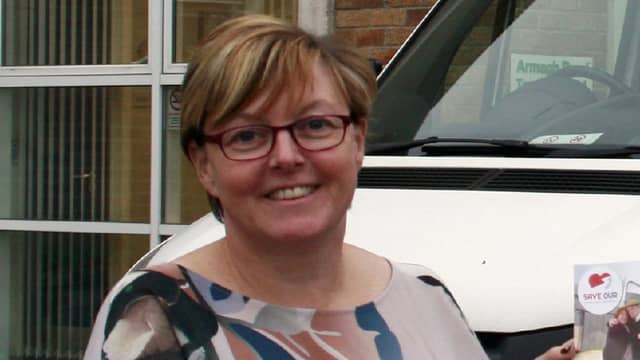
But with the Northern Ireland Assembly and Executive not having governed since February 2022, funding from the Department for Infrastructure is now under serious threat. And although a verbal agreement to continue paying for the service until June has been given, ART manager Diane Irwin (pictured) told the Gazette that until such times as this is confirmed in writing, the stress for all of those affected will continue.
“We have yet to receive our letters of offer,” she said. “Prior to us going off for Easter, the indication was that they would be issued before that happened. But we’re still waiting. It’s radio silence from the Department; there’s nothing coming from them,” she said. “The indication is that money for quarter one will be at the same level as last year, but again we’re very much in limbo with regard to all of this.”
Speculating as to a possible reason for the delay she suggested, “I think the Government at Westminster is holding back on setting budgets here in Northern Ireland because they’re hoping that might push the DUP into returning to Stormont. That doesn’t seem to be working, however, so unfortunately we’re the pawns.”
All told there are 11 Rural Transport projects in NI. Other services similarly affected include Disability Action and Bridge NI.
Last year ACT’s funding was £96,000, with the NI pot having been £2.3 million - a figurative drop in the metaphorical budgetary bucket. And now the fear is that with Westminster reducing its flow of money to NI, this year’s funding – if indeed it materialises and then continues for the remainder of the fiscal year – could be cut by 10%.
“We overspent this year because our expenses were greater than our incomes and you can't continue that long term,” Diane said.
Using the dial-a-lift format, ART has just under 900 registered user members for whom it provides between 850 and 900 passenger lifts per month.
“We have seven drivers and five mini-buses, plus five volunteer drivers who use their own cars,” she explained. “And we’re one of the smaller partnerships; some of the others are a lot bigger than us.
“But some of those others are now starting to lose staff who are becoming increasingly nervous about the fact that there’s no funding. Because of that, they’re finding other jobs and leaving. And when they go, you’re losing their skills, their experience and their expertise.
“All of this is doing big, big damage,” she warned. “I can’t recruit, for example. I advertised for staff just before all this uncertainty started and when it did I had to write to those applicants and tell them that we were having to bench this for the time being.
“So even if we were to get funding, what is the likelihood of those people coming for a job interview? I know I certainly wouldn’t if I was in their position. So that’s going to make it very difficult to move forward and recruit into the sector.”
The Armagh operation has 10 paid staff members, one of whom job shares by working part-time in the office and part-time as a driver.
Diane continued, “The £2.3 million between us and the 10 other Rural Transport groups like us means we’re doing so much good work with very little money. That’s why, for the past three years, we haven’t been able to keep within budget.
“Things are just getting tighter and tougher, so I think the Board will make a decision as to what it to happen. They have to do something because we can’t continue with the way things are going. But the last thing we want to do is cut trips.”
Asked to score her own current positivity at the moment, with 10 being ‘excellent’ and zero being ‘rock bottom’, Diane replied, “Having supposedly got that verbal commitment, I’d say I’m eight right now. But if you were to ask me that same question a month from now when we still hadn’t got confirmation and therefore couldn’t plan a way forward, then I'd probably be down to a four.”
ART - a members only organisation - was set up in March 2000 in response to a need for accessible transport in rural areas. An independent company limited by guarantee, it is also recognised by the Inland Revenue and the Charity Commission.
Its raison d'être is to provide and maintain accessible, affordable and efficient non-profit community transport for people who would otherwise be socially isolated as a result of where they live. It also assists the charitable work of member organisations by providing appropriate community transport services.
Towards the end of our interview , Diane cited the example of an elderly woman whose circumstances mean she is totally dependent on the ART service.
“She lives on the far side of Keady and has no family, so we lift her once a week so she can do her shopping,” she said. “We’re the only people she sees from one week to the next.
“She has nobody, she has nothing and she is very, very isolated. I don’t know what she would do but for us. I don't think she could afford taxis and in view of her age she wouldn’t be computer savvy and therefore couldn’t order groceries online.
“A lot of the members who use us wouldn’t be able to manage those things, so if we weren’t there they’d be dependent on family and friends doing that for them. But there’s only so much you can ask of others. And as well as that, you lose your independence.
“The whole point of us being here is to give that to people and get them out so that rather than becoming totally isolated, instead they’re able to get out and do things. They’re so concerned about all of this that they’re ringing us and asking, ‘Any news of what's happening?’
“At the moment they know we can continue until June, but beyond that they – like us – know nothing and therefore are very worried. That’s why we’re trying to push for a three-year guarantee, because we don’t want to find ourselves going through all this again come next January.”
Asked what she would say to a roomful of NI politicians right now, she replied, “I’d tell them, ‘What you’re doing is affecting so many vulnerable people. You need to start working together for the good of the country. You’re there to represent the people who voted for you and at the minute you aren’t doing that’.”