

Tandragee Scout keeps promise to The Queen
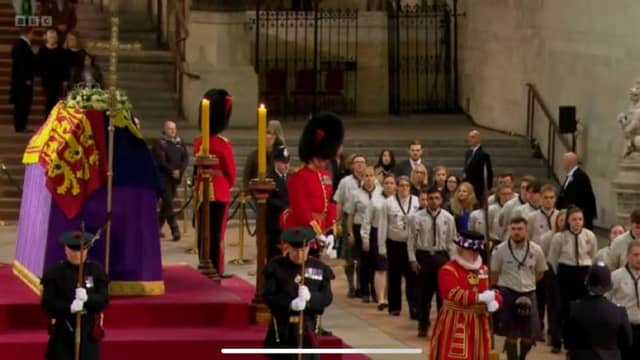

A TANDRAGEE teenager was one of those who helped the 250,000 people who filed past the coffin of the Queen Westminster Hall where she Lay in State from 5pm on Wednesday, September 14 until 6.30am on Monday, September 19. It was respect for and appreciation of the late Queen’s exemplary life of service that prompted Benjamin Abraham to volunteer.
A TANDRAGEE teenager was one of those who helped the 250,000 people who filed past the coffin of the Queen Westminster Hall where she Lay in State from 5pm on Wednesday, September 14 until 6.30am on Monday, September 19.
It was respect for and appreciation of the late Queen’s exemplary life of service that prompted Benjamin Abraham to volunteer.
The invitation to apply was issued by Scouts NI and when the 1st Tandragee Scout Group member and Portadown College A’ Level student forwarded his application, it was one of those accepted.
A total of 120 Scouts from all over the UK were selected to participate in Operation Feather, with Benjamin one the 10 from Northern Ireland, despite the odds appearing to have been stacked against him.
Consider: the age-range for applicants was an unalterable 18-24. Benjamin’s 18th birthday was on Saturday, September 10, the closing date for applications, with a 12 noon cut-off point. It could not have been closer.
Almost certainly he will have been the youngest of all the Scouts chosen from the home nations to assist at Westminster Hall.
“Yes, I probably was the youngest there,” he agreed. “though I’d just point out that although there were 120 of us on the first day, some others were brought in later given the size of the crowds.”
With history being one of his A’ Level subjects, the reality of having been a close-up witness to a real-life historic occasion is one that is still sinking in. Certainly, in order to make his participation possible, he was required to act quickly over the weekend of Friday, September 9 to Sunday, September 11.
Asked about that he replied, “Well, I turned 18 on the Saturday, submitted my application before noon, which was the deadline, got the email to say I’d been accepted on Sunday, and then told school on Monday morning to let them know that I was going to be away for a few days.”
Explaining how and when he first became aware of the fact that a select few Scouts from Northern Ireland were going to be involved in Project Feather, he told the Gazette, “The announcement that Queen had died was made at tea-time on Thursday, [September 8] and a few hours after that, when I was scrolling through my emails, I saw one from our own Scout Group [1st Tandragee].
“It said that Her Majesty was going to be Lying in State and Scouts willing to help with this were needed.”
Knowing that he would – just – meet the 18-years-of-age requirement, he decided to apply. In his on-line application the then-17 year old wrote these words: “The Queen was a public servant to all of us and I just think I should pay my dues to her and serve the public in the same way that she would have.”
Thus it was that he found himself on his way to London, where the eyes of the world would be watching.
Reflecting on that, he told the Gazette, “I'm still working all that out in my mind, because I realise that I was in a very privileged position. It was an honour to have been there. I don’t think I’ll ever forget the experience and I’d imagine that people are going to want to ask me questions about it.”
In addition, his application included his reasons for having decided to become a Scout.
He said, “In explaining why I’d joined Scouting, I mentioned that as well as wanting to learn more about helping others, I’d also wanted to improve myself as a person.”
That is wholly in keeping with The Scout Promise: “On my honour, I promise that I will do my best to do my duty to God and to The Queen, to help other people and to keep the Scout Law.”
Having flown from Belfast to Stanstead, he and the other nine Scouts representing NI were brought to Gilwell Park, the famous Scout Adventures Activity Centre camp site near Chingford, Greater London. Here Benjamin and his colleagues met their counterparts from England, Scotland and Wales alongside whom they would be working for the following few days.
On his first day in Central London he was on duty on the accessibility queue where his role entailed getting wheelchairs for those who needed them, explaining how the queuing system worked, repeatedly offering time estimates, chatting to people, generally keeping them informed and being courteous, friendly and helpful.
When I wondered if his Co Armagh accent was easily understood, he replied, “A few people asked where I was from, but no real problems, thankfully.
“For the last four days of the Lying in State I was on the food banks, which meant taking unopened foodstuff or drinks from people before they went inside. All this stuff was then re-distributed to others further back in the queue who were in more need of it as they were going to be there for a long time.”
Asked how people had responded to having had to surrender foodstuff, he replied, “They were OK with that; I just explained that nobody was allowed to take food inside and told them that so long as it was sealed it would be taken to the food bank. If it wasn’t sealed, we politely asked that those items be dropped in the bin.”
He was there for five days of the Lying in State, and his final shift saw him stationed near the front of the queue, just before it reached the last security check.
“It was just a case of asking people to ensure that their phones were switched off and disposing of any food items or liquids,” is how he described it.
He was also allowed to go into Westminster Hall, which meant that he, in person, got to see what most of us only witnessed on television.
“It was surreal to walk in there in that silence and think, ‘I’m really here; this is really happening’.
“I knew others were watching this on TV and that it was an occasion most people were probably going to remember for the rest of their lives.
“I'm still working my way through all that out in my mind, because I realise I was in a very privileged position and that it was an honour to have been there,” he said.
“I don’t think I’ll ever forget the experience and I’d imagine that a lot of people are going to want to ask me questions about it for a long time to come. And that’s okay; I don’t mind that.”
A stand-out memory is of his time spent working in the food bank at the point where those in the queue had just crossed Lambert Bridge after waiting for upwards of eight hours.
“When they saw all the snacks sitting there, waiting for them, the looks on their faces were something special,” Benjamin said. “Everybody was so happy and grateful just to be getting some food. That was a genuinely powerful thing to have witnessed.
“They weren’t having to buy any of this stuff; it had been bought and then given by others and now we were handing it back to people who really were appreciative. That made a very big impression on me.”
Since he came home last Tuesday, he has been moved by the response of those who know him.
“Everybody seems happy for me. Everybody is curious to know how I got on, what I had to do while I was there, what I made of the whole thing,” he said. “They appear to be glad to see me back– and I myself am glad to be home, too.
“When I and the other nine from NI got on the plane for Stanstead at 9.55 on Tuesday morning {September 13), the Queen’s body was still in Scotland at Balmoral.
“On Wednesday we were all issued with our Queen’s Memorial Badge and the special black scarf which was an essential part of our uniforms for the following few days. It is a privilege to have worn that scarf, because it confirms our participation in a very special occasion.”
Benjamin's duties included shifts from 3pm to midnight, with his work – among other things – having entailed assisting the City of London Police – The Met – with stewarding at the accessibility queue.
He also was involved in the organisation of floral tributes and with offering reassurance to members of the public who were emotionally upset by the solemnity of it all.
“But it wasn't all all work” Benjamin pointed out. “For as well as being well fed and looked after it gave us an opportunity to get to know others and make new friends. All told, it was an amazing experience to have been involved in what was a very special moment in the nation's history in honour of a remarkable monarch.”