

Unearthing history at Navan Fort
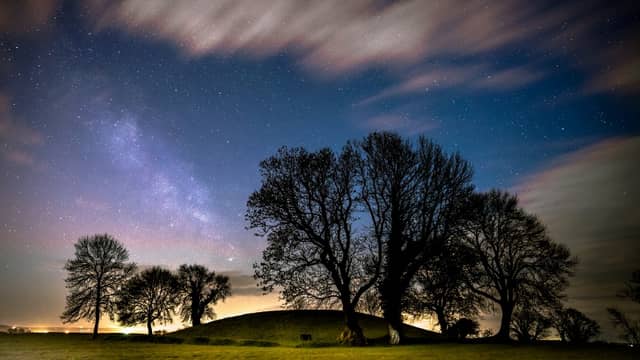

SENIOR archaeologist, Dr Patrick Gleeson gave a fascinating PowerPoint presentation to ABC Development & Regeneration Committee members recently, on the latest finds at Navan Fort, outside Armagh. Among others, the team of archaeologists have found evidence of a large ancient site close to Navan – the largest such site in the whole of Ireland, in fact – and that sensational discovery could make all the difference as part of a current bid for Navan Fort to achieve UNESCO World Heritage site status.
SENIOR archaeologist, Dr Patrick Gleeson gave a fascinating PowerPoint presentation to ABC Development & Regeneration Committee members recently, on the latest finds at Navan Fort, outside Armagh.
Among others, the team of archaeologists have found evidence of a large ancient site close to Navan – the largest such site in the whole of Ireland, in fact – and that sensational discovery could make all the difference as part of a current bid for Navan Fort to achieve UNESCO World Heritage site status.
Work to date has proved so fruitful, in terms of unveiling the scale and significance of newly-discovered archaeological features which have now been identified as being connected to Navan Fort, that Dr Gleeson is currently seeking further funding so that a lot more of the wider site can be scientifically explored.
He told Armagh City, Banbridge & Craigavon (ABC) Borough Council committee members: “Navan Fort is an incredibly important site, and myself and my colleagues have been working on it for about five years.
“We’ve made quite a lot of discoveries when we started our work at Navan.
“Generation after generation have come to invest different significance in this place through time.
“One of the most incredible discoveries is a site [which is] the largest monument on the island of Ireland and completely unknown previously, a hill fort probably late Bronze Age, about 3,000 years old.
“This is an incredibly significant part of Navan’s story and one that adds to its complexity.
“Everything that you see here is a new monument that we’ve discovered through non-invasive survey, and a new monument that adds complexity to our understanding of the site.
“These need to be characterised and dated, because while we can interpret these as archaeological features, without excavation we’re not really able to say what date they are or the exact character of those monuments.
“That’s why we’ve been doing some excavations over the last two years, very kindly funded by the council.
“We’ve been given permission with colleagues in the Department for Community for six excavation trenches and we’ve completed five.
“So far we’ve had an 80% success rate, which means we’ve encountered significant archaeological features in all of those trenches in 80% of cases, all of which are a really good return for a non-invasive survey.
“The first trench is an incredible discovery. This has a series of timber structures and palisade enclosures.
“We think these are part of a large temple complex of the middle part of the Iron Age, so around about 400 BC to 200 or 100 BC.
“What we’re probably looking at is a monument that would have required around about 1,200 posts.
“Thinking about those as pieces of oak that would be 60 to 70 centimetres in diameter, up to three or four meters in height at a very minimum, this is an incredible complex.
“Everything that you see at the site today was built in 95 BC or thereabouts, whereas these are earlier monuments that preceded so they’re probably around about 3,000 to 2,000 years old, and what we have in this trench is an incredible discovery for a variety of reasons.
“It is a completely unique monument for this part of the island of Ireland.
“The next major trench that we have is this monument or this trench. What we have is again a series of pits and features that relate to timber structures.
“In this case it seems to be a palisade, an avenue approaching the interior of the site that again we didn’t know existed as well, as a much later feature that looks like it’s maybe 500 or 600 years old.
“And then finally we did an excavation in the very central monument, in the enclosure that you see today, partly because this is a very enigmatic monument, and what we found is very fascinating. We found evidence that this is a much later structure than we would have previously known.
“Probably this is a mediaeval structure, the first evidence of mediaeval activity at any of these royal sites that include the Hill of Tara and the Rock of Cashel.
“Our star find from all of the excavations were two beautiful objects. Probably an antler pendant that’s been carved on five sides and has a small cut on the top.
“It’s been perforated to be worn around the neck, and this is a very rare object.
“And then [we found] a belt buckle that’s probably from around the early mediaeval period, around the 8th Century, almost pristine, we mistook it for a a bottle top when we found it.
“This is a very rare object and a very high-status object.
“What that leaves us with is an incredible range of new features and new monuments from Navan Fort.
“We now have two millennia of unbroken activity at Navan Fort, whereas we thought its chronology was much shorter previously.”
Councillor Thomas O’Hanlon (SDLP, Armagh DEA) explained that he had seen for himself the extraordinary detective work of the team of archaeologists at the site: “I’ve had the privilege to come out and meet you and the team as part of the dig, and I have to say I’ve been very impressed by what has been found.
“For those of us of Armagh heritage, we always have valued the importance of Navan. In terms of your assessment of the strategic importance of this site, both on the island of Ireland and across Europe, maybe I would just ask for a comment in relation to that.”
Dr Gleeson replied: “I think what we’re discovering is going to add incredible weight to the UNESCO bid, because of the fact that we can now point tangible mediaeval evidence, which is very rare at these sites.
“That’s the missing piece of the puzzle and that’s partly the reason they’ve been nominated to UNESCO in the first place.
“I think what’s important is that the situation of Navan, in a landscape that is now known to [have been] incredibly significant for a very very long period of time, lends weight to that idea that essentially the reason Patrick founded Armagh on the Hill of Armagh and Cathedral Hill, is because of its significance as a part of that vast and incredible ritual landscape.
“So it does seem now pretty clear that we have evidence of a very important cult centre, cult landscape, with Incredible religious and ritual significance, from the Bronze Age through the Iron Age to the very cusp of the early mediaeval the period.
“Actually, we have some radiocarbon dates from Navan Fort that are from the lifetime of St. Patrick himself.
“[There is also] the significance of the scale that we’re now appreciating in our work, in terms of understanding the much bigger monuments in the nearby vicinity around Navan. It makes it much more compelling.
“We have these incredible monuments stretching the landscape to the West. That makes it much easier to stretch the landscape to the East and include Armagh as a part of that spectrum.
“I don’t think Armagh was founded without the incredible significance of Navan Fort as a pre-existing focus for ritual activity in that landscape.”
Councillor John Óg O’Kane (Sinn Féin, Armagh DEA) asked: “It was good to hear that you had a percentage of 80% find, which is high. Have you any future plans for more digs coming?”
Dr Gleeson explained: “What we use to identify archaeological features is a non-invasive survey method. We use magnetic radiometry, electrical resistance which measures the properties of the soil to determine where disturbance is.
“It’s very rare then to find out that the vast majority of what you’ve recognised as an anomaly in those surveys is actually archaeological.
“In this case it seems that an unusually high percentage of what we’re identifying is turning out to be significant and archaeological, and belonging to a very early period.
“When we detect a structure that could be built in the 19th Century or 2,000 years ago, that’s what we have to excavate to find out.
“It stands to reason that excavation is a hugely important element in our toolbox.
“At the moment we’ve sort of exhausted our remit in terms of the funding which is very kindly being given by the council.
“For the most part the main monuments were constructed in and around the 1st Century BC, but yet we know that there’s activity stretching 2,000 years, 3,000 years before that, and perhaps 1,500 to 2,000 years after that.
“It’s my job to seek funding for that, to make this into a much larger project, and one that’s maybe perhaps more comparative in a North-Western European context, so that’s the next task for me as the archaeologist in charge.”