

'Use it or lose it' – the need to support local businesses
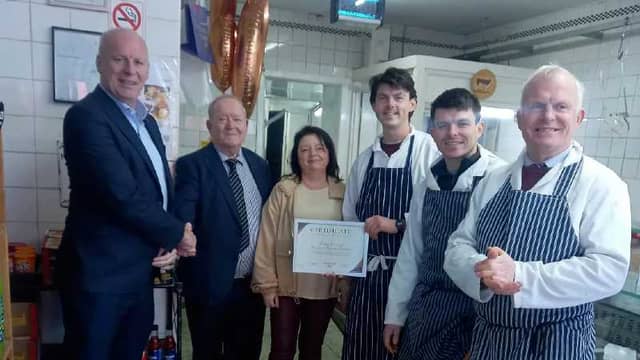

OVER the years Armagh has been blessed to have had numerous high quality family-run businesses. Older Gazette readers will still have fond memories of two top-class department stores which sadly are no more – A. Lennox and Sons which began trading in 1887 and continued to do so until 1998 and fellow-centurions T.J. Walkers who were in business from 1911 to 2014.
OVER the years Armagh has been blessed to have had numerous high quality family-run businesses.
Older Gazette readers will still have fond memories of two top-class department stores which sadly are no more – A. Lennox and Sons which began trading in 1887 and continued to do so until 1998 and fellow-centurions T.J. Walkers who were in business from 1911 to 2014.
But as American-born investor, billionaire John Templeton, once urged a journalist, “Tell your readers to use it or lose it. If you don't use your muscles, they get weak. If you don't use your mind it begins to fail.”
The same is true of local shops, alas, with the loss of butchers and bakeries providing proof of that fact here in Armagh.
At the end of November past, when Gareth Downes took over as the new owner of Johnston’s famous bakery at the bottom Scotch Street, he told the Gazette that one of his reasons for doing so was that he “thought it would be a sin to stand back and let such a well-known shop as this close.
“That was going to mean no home bakeries with a shop front left in Armagh, whereas at the time when I was an apprentice there used to be five or six.
“I thought it would have been real shame to let it close down.”
The Johnston family handed over the keys at the end of trading on November 25.
But that same day saw another long-standing Scotch Street business – A. [Andrew] Flanagan and Son’s butchery – close its doors for the last time, this after 92 years of business. Its departure means there are now only two family-run butcheries in Armagh City – P. [Patsy] Leonard of Lower English Street and The Butcher in Upper English Street.
The former recently celebrated 60 years of business.
Patsy began his apprenticeship with McErlain’s in Belfast in the mid-1950s – when there was a rail service between the two cities – and then switched to Lewis’ Butchery in Armagh. And by 1963 he felt sufficiently qualified and competent to risk opening up his own business, this despite the fact that there were already 14 butcheries in Armagh at the time. With the help and support of his brother Sean, who is now deceased, he rose to the challenge, witnessed by the fact that six decades on, it remains in family hands and is still going strong.
In due course, Patsy’s son, Martin came on board, working alongside his father. And now a third generation of the Leonard family – Martin’s sons Philip and Patrick – are committed to maintaining the heritage.
Philip’s appreciation of the work done by his father and grandfather shone through when he told the Gazette, “There was plenty of competition from other butchers when my grandfather opened up, so all that competition probably helped to keep him on his toes.
“He built it up well by making good decisions at the right time. And my father is like him in that he has never taken shortcuts, either. They always put the emphasis on quality. Always.
“And my father continued to do that when his father retired. Well, I say ‘retired’ but the truth is that even though he's now 87 he still keeps an eye on what’s going on. He’s fully lucid; he has his wits about him.”
Pointing to his grandfather’s strengths he continued, “I think one of them is that he has always been content rather than stressed. I say that because although he has been prepared to make decisions, he has always taken everything in his stride, even if it didn’t come off.
“Another of his strengths has been that he has known times change and so has always been willing to move with them.”
As with those whose example he is now trying to follow, Philip emphasised the importance of adaptability.
“Convenience food, for example, is available now more than before, so there's probably not as much cooking been done as in the past; a lot of young ones, especially, don’t seem to want to be bothered,” he said.
“But while that'’ true, there’s also plenty of young people who enjoy good food - and there’s no shortage of recipes from social media like Tik-Tok or Instagram to keep them interested, so there’s still a demand for good meat.
“A lot of people of my generation are happy to try new things, so sometimes they want advice about different cuts or cooking times, for example. And that’s where I think the likes of us score.
“Because we have the full hind quarters, we can take exactly what the customer wants off that. That means we’re catering for specific needs whereas the supermarket or the garage shop – no harm to them – can’t do that.”
And in keeping with the ‘keeping it local’ ethos he stressed, “We buy our meat from local people and sell it to locals, too.”
Then acknowledging another of society’s changes he pointed out, “My grandfather had a farm on the edge of town, so he reared and slaughtered his own beef, whereas nowadays it’s more cost effective for us to buy from suppliers whose quality we know we can trust.
“A lot of our pork, for example, comes from Pinkertons, who – like us - are locals. In turn, we then supply most of the local restaurants and coffee shops, so it's locals supporting other locals all the way down the line, which is what you want to see because it means everybody benefits.”
Face-to-face, first-name relationships with customers are an important string in a local shop’s weaponry and that was another fact Philip underlined by telling the Gazette, “We still have customers who were coming here long before I was born; they’re probably even more familiar with the shop than I am!
“I’ve been working in the shop full-time for five years now, but because of my grandfather and father always having been here I was in and out of it from I was no age.
“I’m now serving customers whose grandparents and parents shopped here when my grandfather and father were behind the counter. Those are relationships built over years, based on trust and respect and quality.”
So is the situation regarding continuation of local shops in Armagh a clear case of use it or lose it? That certainly would appear to be true; just count up how many have already gone, never to return.
We opened with a quote by John Templeton and we close with another from American author and journalist, Richard Paul Evans, who warned: “I don't think it’s as much a human foible as it is a human curse that we cannot understand the beauty of a thing until it is gone.”
With that thought in mind, let’s commit to supporting Armagh’s local traders where possible. If we don't, by the time we realise what we have done by failing to do so, it may be too late.
And then what?
More on our ‘Shop local. Eat Local. Read Local’ campaign on page 25.